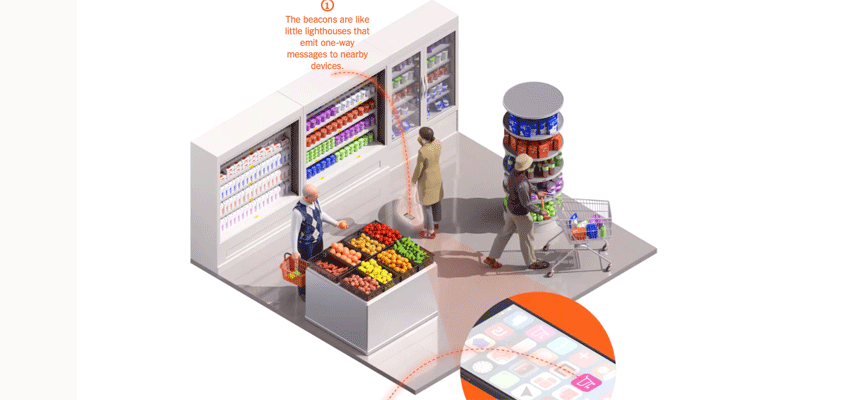
Tim Cook wishes iBeacon was as pervasive and effective as The Privacy Project makes it sound.
From Michael Kwet’s “In Stores, Secret Surveillance Tracks Your Every Move,” in Sunday’s paper:
Imagine you are shopping in your favorite grocery store. As you approach the dairy aisle, you are sent a push notification in your phone: “10 percent off your favorite yogurt! Click here to redeem your coupon.” You considered buying yogurt on your last trip to the store, but you decided against it. How did your phone know?
Your smartphone was tracking you. The grocery store got your location data and paid a shadowy group of marketers to use that information to target you with ads. Recent reports have noted how companies use data gathered from cell towers, ambient Wi-Fi, and GPS. But the location data industry has a much more precise, and unobtrusive, tool: Bluetooth beacons.
These beacons are small, inobtrusive electronic devices that are hidden throughout the grocery store; an app on your phone that communicates with them informed the company not only that you had entered the building, but that you had lingered for two minutes in front of the low-fat Chobanis…
It should not be lost on the public that Apple created the first Bluetooth system of commercial surveillance. Apple’s chief executive, Tim Cook, recently wagged his finger at the “data-industrial complex.” Unlike other tech giants that monetize surveillance, Apple relies upon hardware sales, he said. But Mr. Cook knew what Apple was creating with iBeacon in 2013. Apple’s own website explains to developers how they can use iBeacon to micro-target consumers in stores.
My take: Even the paranoid should do their due diligence.
My first Google hit: Ben Lovejoy’s iBeacon adoption reduced to a trickle, posted last October on 9to5Mac.
Beacon adoption has been all but abandoned by most retail chains, suggests a report today.
iBeacons and other beacons were once touted as a technology that would revolutionize retailing. They would help us find products in-store, provide easy access to detailed information on our iPhone when looking at a product display, and beam us discounts and offers to help us save money.
The reality, however, hasn’t lived up to the hype …
But while beacon adoption is continuing—Walmart, Rite Aid, and Target among those still trialling the technology—most other big retail chains seem to have lost interest.


Why let the facts ruin a perfectly good story?
Read thru the comments on the linked 9to5 Mac article. This is a good one:
“The beacons themselves don’t enable such tracking actually. If you’re logged into the app that receives the beacon notification then it can phone home, but the beacon hardware receives no information about the identities of the phones around it other than usual Bluetooth identifiers (which software on the phone can’t access).”
In a true “push only” operation, you’d receive anonymously.
Beacons?
The writer might just as well have written about the irrelevance of 3D TVs except there would be no chance for anti-Apple spin in the NYT.
BB’s (bluetooth beacons) exist, and yes, Apple’s were first. Can the tech be abused? Yes, along with most tech. Our cell phones can be tracked, as the article points out, if someone wants to go to that trouble and expense.
Are those installing BB’s abusing them? Sounds like it, in some cases, although there’s a LOT of surmise and innuendo in that article, whose whole thrust seems to be skewering Apple for it’s “hypocrisy” in having created and sold a device that is capable of being abused. It’s also capable of being very helpful. You’ll notice that that aspect of BB’s is conveniently given very short shrift in the NYT’s article.
And why the vociferous focus on the one tech company trying to actually do something about privacy? Because of the author’s perception of hypocrisy? Isn’t that throwing the baby out with the bathwater?
If the article had limited itself to educating us on the abuse of BB’s, that would have been one thing, particularly if it had come up with a solution other than not using it. But that’s not what it did. Instead, it stooped to getting clicks by attacking Apple, and Apple alone.
So is there a solution that anonymizes the BB user? Clearly, one solution is to let the user access the BB anonymously! Why should a Target or WalMart app be required to get a push notification that a product is near that’s on sale?
But see, solving the problem of BB’s would have legitimized BB’s development and production. And the author couldn’t have that, now could they?
Oh poor me.
I’ve had iPhones for over a decade and never once got a push notification in any retail store.